Rio Grande Valley: Texas's Next Commercial Real Estate Frontier
Population growth, cross-border trade, and infrastructure investment are converging to make the Rio Grande Valley one of the most compelling commercial markets in Texas.

Rio Grande Valley: Texas's Next Commercial Real Estate Frontier
For decades, the Rio Grande Valley operated on the periphery of Texas's commercial real estate conversation. Investors focused on Austin, Dallas, Houston, and San Antonio — the four major metros that dominated deal flow, capital allocation, and media attention.
That is changing. And the investors who recognize the shift early will be the ones who benefit most.
A Market That Has Been Hiding in Plain Sight
The Rio Grande Valley — anchored by McAllen, Brownsville, Harlingen, and Edinburg — is home to approximately 1.4 million people and growing. The region's population growth rate has consistently outpaced the state average, which itself outpaces the national average. That is a compounding demographic tailwind that drives demand for every category of commercial real estate: retail, office, industrial, medical, and mixed-use.
What has historically kept institutional capital on the sidelines is a combination of perception and infrastructure. The Valley was seen as a secondary market with limited exit liquidity and a tenant base dominated by smaller regional operators. Both of those dynamics are shifting.
The Cross-Border Trade Engine
The Rio Grande Valley sits at the intersection of two of the largest economies in the Western Hemisphere. The Port of Brownsville and the Pharr-Reynosa International Bridge collectively process billions of dollars in cross-border trade annually. USMCA has reinforced Mexico's role as a manufacturing hub, and nearshoring trends — companies moving production closer to U.S. consumers — are accelerating investment in northern Mexico's industrial base.
That activity does not stay on the other side of the border. It creates demand for logistics infrastructure, warehousing, professional services, and workforce housing on the U.S. side. Harlingen, positioned at the geographic center of the Valley with direct access to U.S. Highway 83 and State Highway 77, is particularly well-situated to capture that demand.
Infrastructure Investment Is Arriving
The Valley has seen meaningful public and private infrastructure investment over the past several years. The expansion of Valley International Airport in Harlingen, ongoing improvements to the Port of Brownsville, and continued investment in healthcare infrastructure — Valley Baptist Medical Center, DHR Health, and the University of Texas Rio Grande Valley's medical school — are all signals of a market maturing into a more institutional-grade investment destination.
Healthcare in particular is a significant driver of commercial real estate demand. Medical office, outpatient facilities, and ancillary retail follow healthcare infrastructure investment with a lag of two to five years. The Valley's healthcare buildout is still in its early stages relative to the region's population size, which means the demand pipeline for medical-adjacent commercial space is substantial.
Retail Follows Rooftops
The Valley's retail market has historically been dominated by a handful of major corridors in McAllen and Brownsville. As the region's population spreads and income levels rise, retail demand is following — and secondary markets like Harlingen, Edinburg, and Mission are seeing increased interest from regional and national retailers looking to establish or expand their Valley presence.
The key metric to watch is household income growth. The Valley has historically had lower median household incomes than the state average, but that gap is narrowing as the region's economy diversifies beyond agriculture and trade. A growing middle class with increasing purchasing power is the foundation of a healthy retail market.
What LOCAL Real Estate Group Is Seeing
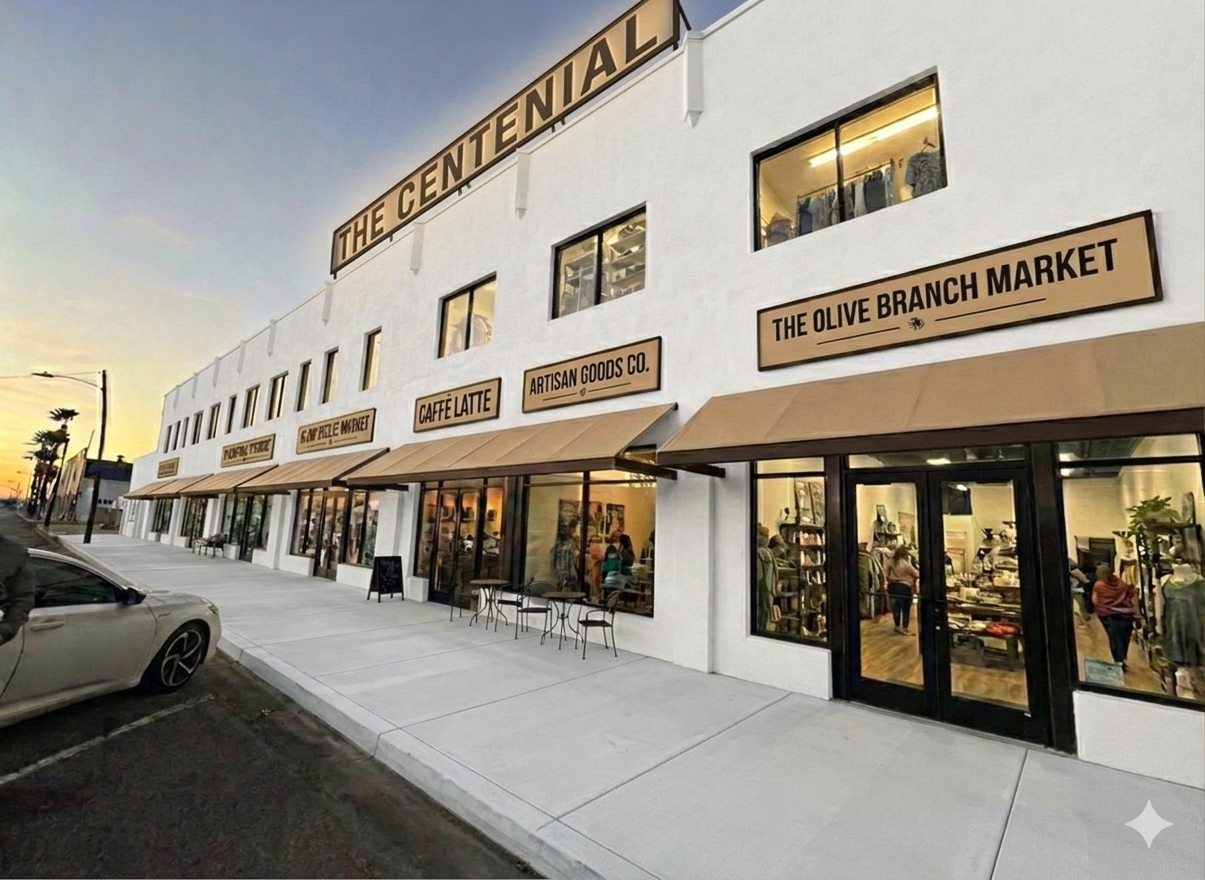
Our development of The Centennial at 504–516 W Jackson Street in Harlingen is a direct expression of our conviction in the Rio Grande Valley's commercial real estate fundamentals. We chose Harlingen specifically because of its central location within the Valley, its established downtown infrastructure, and the quality of the tenant demand we are seeing from businesses looking to establish a foothold in the market.
The Centennial is one project. But it reflects a broader thesis: the Rio Grande Valley is at an inflection point, and the commercial real estate opportunity that comes with that inflection is significant.
Getting Ahead of the Curve
The best commercial real estate investments are made before a market is fully discovered — when cap rates still reflect the perception of risk rather than the reality of demand. The Rio Grande Valley is at that stage today.
Investors who wait for the Valley to look like Austin or San Antonio before committing capital will find that the best opportunities have already been taken. The time to build relationships, evaluate sites, and position for the market's next phase of growth is now.
Interested in commercial real estate opportunities in the Rio Grande Valley? Contact LOCAL Real Estate Group to discuss what we are seeing in the market.
Explore Topics
Written by
LOCAL Real Estate Group
Content creator and writer sharing insights and stories.